The short answer is, no. But as any good lawyer knows, the correct answer to any question is “depends”. When it comes to AI, there are several “depends”. Depends on what you want to do, depends on how fast you need to do it, depends on what you mean by AI.
That last “depends” warrants some greater explanation, so first a quick recap is in order. Much of this is covered in greater detail in my post from April titled Is AI Safe but let's start with some definitions.
According to the ABA, there are 1.3 million lawyers in the United States and 1 in 4 are in just two states, New York and California. Here in Louisiana, we have 23,038 lawyers at last count.
Depending on your location, a law firm that has between two and 50 attorneys might be considered “small” or “mid-sized.” The ABA considers up to 50 as “small” while ILTA says up to 100. In a small town, a firm of ten attorneys might be considered mid-sized, but in Chicago, that would be considered fairly small. In a big city like New York or San Francisco, a firm of 100 would be considered small but in New Orleans, it would be large.
What we do know is the Bureau of Labor Statistics reports that 25% of all lawyers are in a solo practice, the 2022 State of US Small Law Firms from Thomson Reuters Institute and the ABA Solo Small Firm Division reports firms with between 11 and 29 as 23% of the market. As market analyst Joe Patrice once remarked in an Above the Law column called Small Law Is Huge, “Seventy-five percent of all U.S. attorneys are in private practice, and the overwhelming majority of those are in small firms.”
For purposes of this discussion, I’m going to assume “Small” means less than 20 lawyers. I do so because I think we can safely assume they are the least likely to have any internal IT staff.
Small firms also typically have small cases. Where does that measurement fail? We’ll talk about it more throughout this article but I’m going to say a small case will be less than a million documents or, alternatively, less than 500GB of data.
Usage of eDiscovery software is typically reported if it is reported at all, as not being used by this demographic. I disagree with that assessment of small firms (see my article at https://tinyurl.com/awvrzkkt ) but do agree that using eDiscovery software is a difficult decision for small firms for both technical and financial reasons.
So where does that leave us in assessing the use of AI?
AI projects have been underway for years, from René Descartes and his 1637 Discourse on the Method of Rightly Conducting One's Reason and of Seeking Truth in the Sciences, until the formal Dartmouth conference of 1956, widely considered the "birth of AI".
What we commonly call human intelligence are tasks people perform that combine a variety of cognitive processes, including logical thinking, strategy development, planning, and decision-making. Good examples are playing chess, writing computer codes, translating languages, and even driving a car.
When scientists or engineers automate such an activity, it is called AI and some academic sources distinguish between “weak AI” (or narrow AI), which is not intended to have general cognitive abilities but is designed to solve exactly one problem and reserve the term "strong AI" for computer programs that emulate or experience sentience or consciousness.
AI has been widely used in the general commercial world for years. The latest annual McKinsey Global Survey found that the three most common uses in the business world are marketing & and sales, product development, and service operations. Other common uses include:
- Maps and Navigation
- Voice Recognition
- Speech Dictation
- Facial Detection and Recognition
- Text Editors or Autocorrect
- Search and Recommendation Algorithms
- Digital Assistants
- Social Media
- E-Payments
- Chatbots
- Real estate and property management
Take a look at this graphic for more examples

Source: Evolving AI Lab
AI is in widespread use throughout the legal environment as well. In a recent discussion of judges hosted by PLI and moderated by former US Magistrate Judge Ronald Hedges, panelist Ken Withers, the Deputy Executive Director of the Sedona Conference, noted that AI is ingrained in many apps and platforms these days, saying “… many of us are using it without even realizing it.”
In his coverage of the panel, Doug Austin of EDiscovery Today mentioned the widespread use of AI in the single platform example of Microsoft Word. In creating documents, it may use text predictions where it suggests the completion of a word or phrase based on what you’ve typed so far, Grammarly, for spelling and grammar checking, and Dictate feature for speech-to-text capability. All of these are AI. ( https://ediscoverytoday.com/2023/08/11/some-judges-may-have-trouble-distinguishing-between-ai-and-gen-ai-artificial-intelligence-trends/ )
Ryan Hemmel of ProSearch continued that theme with an article on how AI is coming to Microsoft 365. The article, AI Is Coming To Microsoft 365: What You Need to Know, was published in Law Journal Newsletters and is available here. A more recent article on AI in the Microsoft environment appeared literally as I writing this. https://www.linkedin.com/feed/update/urn:li:activity:7100491077224189953/
The point is, that we have been using AI in our profession for everything from “weak AI” in ubiquitous chatbots to “strong AI” in contract review and much more, including:
- Due Diligence
- Witness background information
- Predictive technology
- Legal Analytics
- Document Automation
- Intellectual Property Analysis
- Access to Justice
- Legal research
- Case management
- ADR
In fact, many vendors are now calling AI what they used to call analytics and before that TAR or CAL.
It is, however, in the area of litigation where the use of AI becomes a bit more complicated. Another panelist on the PLI panel mentioned above, retired Magistrate Judge James Francis from the Southern District of New York, discussed some of the problems that arise in the litigation arena when he mentioned that the term “AI” has become overly broad because what is often really meant is “generative AI”.
What exactly is generative AI and why is it important?
Generative AI is a type of “strong AI”, which, at its core, works by training software models to make predictions based on data without the need for explicit programming.
Specifically, generative AI models are fed vast quantities of existing content, commonly referred to as foundation models (FMs), which are trained to produce new content. They learn to identify underlying patterns in the data set based on a probability distribution and, when given a prompt, create similar patterns or outputs based on these patterns.
This process is often called deep learning and the use of these large neural networks allows it to handle more complex patterns than traditional machine learning. Modeled after how humans think, these neural networks do not necessarily require human supervision or intervention to distinguish differences or patterns in the training data.
The problem, according to Mary Mack, CEO and chief legal technologist at EDRM, is that the types of use cases, models chosen and approaches taken to layer in generative AI vary significantly from vendor to vendor, CF, “Generative AI in Legal: Investigating the Rise of Intelligent Counsel” webinar (https://www.jdsupra.com/legalnews/webinar-generative-ai-in-legal-8209663/)
A subset of FMs is called large language models or LLMs.
A large language model is a trained deep-learning model that can use up to trillions of words to train and then “understand” and generate text in a human-like fashion.
WARNING ... THIS IS WHERE THINGS GET TECHNICAL

The size of an LLM is typically measured as the number of parameters it contains. What is a parameter? The term refers to the numerical values that determine the behavior of the model. These parameters include weights and biases, which together define the connections and activations of neurons within the model.
The training process involves adjusting these parameters (weights and biases) iteratively to minimize the loss function. This is typically done using gradient descent or a variant thereof, such as stochastic gradient descent or Adam optimizer. The loss function measures the difference between the model's predictions and the true values (e.g., the correct next word in a sentence). By minimizing the loss, the model learns to generate text that closely resembles the patterns in its training data.
Got that? No? Yeah, me either. But here’s what’s important for the purposes of this discussion.
GPT-4 has been speculated to have 1,700 billion parameters and the largest LLM, Llama-2 from Meta, has 70 billion parameters. The size of an LLM is important because certain capabilities only emerge when models grow beyond certain sizes. Ione study, by Jerry We and Denny Zhou, of Google Research, showed that some mathematical and word skills appear in LLMs only when they grow past certain sizes and have been trained for long enough (measured in training FLOPs). https://ai.googleblog.com/2023/05/larger-language-models-do-in-context.html
I won't even go into training FLOPs. It would only confuse me while watching the Pelicans play the Warriors.
A further problem is the one Mary Mack mentioned above. Many vendors use what one company calls a model-agnostic or “multimodel approach”. They are not tied to any specific LLM, such as OpenAI’s popular GPT models, and may use, instead, several of the publicly available models in the development stage, including Claude, PaLM, LLaMA, GPT, and more. They swap models in and out depending on which are better at specific tasks, and you may not, in fact probably do not, know what model is being used for any specific part of the process unless you ask.
This can be a highly successful approach if done properly. Merlin Search Technologies for example offers an AI-powered eDiscovery platform that accesses GenAI products from multiple vendors because they believe it affords the flexibility to use the best, most cost-effective LLM for each task required. For example, the most sophisticated, but more expensive, LLM models can be targeted for use for synthesis, analysis, and reports where they are most effective. https://www.merlin.tech/multi-llms/ .
Do we see that in small cases? No. What’s important for our discussions is the size considerations and the fact that generative AI needs a certain amount of data to train itself. VAST amounts of data, literally trillions of words.
If we assume that a megabyte holds about 500 pages of text, we can extrapolate that a GB (which is 1000 MB) has 500,000 pages. If one page is 250 words then a GB has roughly 125 million words.
Now from the seat at my desk here in the Fairgrounds neighborhood of New Orleans, I can just faintly hear the sound of the top of Craig Balls' head exploding like Mt. St Helens in Washington back in 1980. Craig has railed about page equivalencies since, well since 2007. www.craigball.com/Page_Equivalency.pdf And more recently in 2014 with https://craigball.net/2014/01/15/revisiting-how-many-documents-in-a-gigabyte/ where he quoted another great legal technologist more adept in those calculations than me, John Tredennick, the founder and CEO of Merlin Search Technologies.
On the other hand, Craig once said that 200 TB was far more than the amount of data stored in the Library of Congress. Now granted, that was in 2015 and the data set of the LOC collections that were digitized and freely and publicly available on the Internet was about 74 terabytes. But that number, which was comprised of roughly 32 million books, represented only about one-quarter of the entire physical collection.
The majority of the LOC collection, then and now, consists of manuscripts, prints, photographs, maps, globes, moving images, sound recordings, sheet music, oral histories, etc. Current estimates are that the LOC has more than 170 million items in its collection which take more than 3.5 petabytes of storage space to contain. A petabyte contains 1000 TB.
So for purposes of our discussion, let’s assume that a Unicode pst-file or ost-file can grow as large as 20GB in Outlook 2007 and 50GB in Outlook 2010, 2013, 2016, 2019, and M365. (That figure can be larger in M365 but let's use the default size for this example) So in a modern email box, you have a limit of six billion two hundred fifty million words.
For the entire email box.
Since there are 1000 billion in a trillion, it appears we’re a few billion short of the critical mass for the effective use of AI. Hence the common joke in mathematical circles, “How much data is required to train a deep neural network (DNN)? More than you have.”
I know what you’re thinking. I may have more than one email box and lots of other data types in a given case. But are you going to have the trillions of words necessary to trigger a good use of generative AI? Probably not. And remember, you’re using GAI to do analysis, not first-pass searching.
The point is, you need a data set sufficiently larger than the average small case to have an effective generative AI implementation. Readers old enough to remember the early days of CAL and predictive coding may recall that has always been the case. Early concept clustering programs also needed a sufficient number of documents to build their indices.
Even today, some visual analytics programs are only useful for “ … large amounts of complex data sets and analytical processes that require a great deal of interaction and monitoring.” (https://www.heavy.ai/technical-glossary/visual-analytics)
So to conclude this point, generative AI is not going to be useful for the data collection sets that most small firms will see. In fact, Dan Gallivan, quoted above, told me, “All of our recent cases that have used “AI” have been 1) document corpuses in excess of ~1 million files, and 2) only used to prioritize the order in which review happened.”
Again, most decidedly NOT small cases.
There are several other issues to consider when discussing generative AI including the proprietary nature of some databases, hallucinations, privacy, and cost.
The most well-known LLMs released by OpenAI (ChatGPT, GPT-4) are proprietary models - you are not able to download the models, they are only accessible via a UI on their website or via API calls. For example, you pay OpenAI to use the higher end LLMs (GPT-4) and build commercial applications that call their models via APIs.
Technically you could build something yourself. Many large firms are doing just that because there are now hundreds of open-source LLMs available. Currently, the most powerful is Llama-2, released by Meta in July 2023, with 70 billion parameters.
Open-source LLMs have the advantage over proprietary models in that they can be fine-tuned for task-specific goals. Organizations may have valuable proprietary data (such as their customer help data or internal documentation) that they can leverage to build custom LLMs with fine-tuning. Open-source LLMs also enable organizations to deploy models within their own data centers or cloud accounts, so sensitive data will not leave their network.
However, the largest open-source LLMs are still an order of magnitude smaller than the largest proprietary LLMs, so their performance is still not as good for general-purpose language tasks.
And you’re simply not going to do that. You’re a small firm. Maybe even a solo You use a vendor who has a product that does this and pay them to use it.
“What we do know today is that language models can be fickle and they can be unreliable,” said Dr. Rumman Chowdhury of the nonprofit Humane Intelligence, an organizer of the recent Def Con event in Las Vegas. (https://defcon.org/ ).
The next problem is what the article Is Disclosure and Certification of the Use of Generative AI Really Necessary?, written by Maura R. Grossman, Paul W. Grimm, and Daniel G. Brown for the forthcoming October 2023 issue of Judicature, called “GenAI’s propensity to hallucinate.”
A great example is the sample query posted to OpenAI's GPT playground asking, “Who is King Renoit?” It will tell you that King Renoit was a French king who reigned from 1515 to 1544. In fact, he did not exist at all.
Asked further, “Was King Renoit real?”, it responded “ King Renoit is not a real historical figure. He is a fictional character from the French epic poem Song of Roland, written in the 11th Century.” King Renoit is, in fact, not a character in the Chanson de’Roland.
Why do some AI programs hallucinate? In a general sense, without specific guidelines, if you ask for studies on a subject, it will make studies up because it doesn't have any studies actually stored anywhere, only a rough representation of what it has been trained with.
Bobby Malhotra, a partner at Winston & Strawn, discussed this issue in the recent webinar hosted by the EDRM called “Generative AI in Legal: Investigating the Rise of Intelligent Counsel” and cited above. He stated,
“That can happen for a number of reasons, including lack of context. Models understand language really well. They don’t understand context. There could be bias in training data. There could be errors in the model or the underlying data that was used to train the data,” Malhotra explained. “So there’s several reasons why you can get hallucinations.”
In programming, guardrails are sets of rules, standards and best practices related to the development pipeline, from coding and building through testing and release. AI guardrails, especially in generative AI LLM models, are safety mechanisms, providing guidelines and limits to ensure that AI systems are accurate, secure and appropriate with regard to ethical standards and societal expectations such as privacy.
Asked the King Renoit question, a program with guardrails will say it doesn't know and avoid answering the question. It’s what makes chatbots work. When you go on to your cable TV website, you may be asked “do you have an existing account or do you want to open an account’ and you answer, “Existing account”. The chatbot will then prompt you “Is this a question about your bill, tech support, adding services or ordering a PPV event”. You won’t get a map of the solar system. And if the system does get stuck it says , “I can’t answer that, would you like to talk to a customer rep?”.
Christopher Mims, in Why Artificial Intelligence Isn’t Intelligent. (https://tinyurl.com/sepyzmhc) says that
“When AI researchers say that their algorithms are good at “narrow” tasks, what they mean is that, with enough data, it’s possible to “train” their algorithms to, say, identify a cat. But unlike a human toddler, these algorithms tend not to be very adaptable. For example, if they haven’t seen cats in unusual circumstances—say, swimming—they might not be able to identify them in that context. And training an algorithm to identify cats generally also doesn’t increase its ability to identify any other kind of animal or object. Identifying dogs means more or less starting from scratch.”
This issue is called curation and explains why AI can often be wrong. AI is good at finding words, not concepts and when you search large amounts of data for one issue, but it has thousands of issues in the corpus, lack of proper curation will detract from accuracy.
For more on this, see my previous articles at www.digitalwarroom.com/blog/legal-ai-misses-the-bullseye and https://technogumbo.blog/2021/07/25/is-the-new-nist-standard-for-ai-looking-at-the-wrong-end-of-the-horse/
The security and ethical concerns around the use of AI are widespread. In the “Generative AI in Legal: Investigating the Rise of Intelligent Counsel” webinar mentioned above, Bobby Malhotra stated, “The one fallacy that I’m hearing quite a bit is, I’m using a tool that kind of connects with ChatGPT or Bard via a private API, so my data is not being transmitted. The reality is there’s going to be bits and pieces of your data that is going to be transmitted,”
He added, “These companies may say they don’t hold onto the data for longer than X amount of time, for the entire period of an HTTP session or whatever that timeframe is. But the underlying concern is, even if the data has been held for a minimal amount of time, or is deleted or removed nearly instantaneously, there is still data that’s being transmitted.”
As Mary Mack noted in the same webinar, “It runs the gamut of the tools that they’re using. Some of them are using the tools that are in the cloud, others are using more of a private [alternative]—but how private, that’s another discussion,”
It was exactly these type of issues that prompted passage of the AI Act in Europe, the world’s first comprehensive AI law. Unlike the GDPR, where the obligations, liability and accountability for how personal data are processed are assigned to 'controllers', under the AI Act (set to go into effect in January of 2024) 'users' will take the place of 'controllers' in the deployment phase of AI systems.
There is no such regulation to date in the US although IP issues have arisen with entities from the New York Times to entertainer Sarah Silverman alleging copyright violations by AI algorithms. https://www.npr.org/2023/08/16/1194202562/new-york-times-considers-legal-action-against-openai-as-copyright-tensions-swirl
Various US agencies, including the Copyright Office and even the White House are preparing AI guidelines, https://www.reddit.com/r/ChatGPT/comments/12zinur/new_copyright_law_on_aigenerated_content_in/ and at the ABA Midyear Meeting in May of this year, the Cybersecurity Legal Task Force submitted Resolution 604, which addressed how attorneys, regulators and other stakeholders should assess issues of accountability, transparency and traceability in artificial intelligence.
It called on organizations that design, develop, deploy, and use AI to follow these guidelines:
- Developers of AI should ensure their products, services, systems, and capabilities are subject to human authority, oversight and control.
- Organizations should be accountable for consequences related to their use of AI, including any legally cognizable injury or harm caused by their actions, unless they have taken reasonable steps to prevent harm or injury.
- Developers should ensure the transparency and traceability of their AI and protect related intellectual property by documenting key decisions made regarding the design and risk of data sets, procedures and outcomes underlying their AI.
Privacy with AI systems also continues to be a major concern for attorneys in the US however as commentators continue to raise questions concerning confidentiality and waiver of attorney-client privilege. CF, https://www.law.com/legaltechnews/2023/01/26/chatgpt-and-ethics-can-generative-ai-break-privilege-and-waive-confidentiality/ and https://www.plunkettcooney.com/litigation-defenders/artificial-intelligence-attorney-client-privilege
John Tredennick at Merlin disagrees with those concerns saying, “Could using powerful AI tools like GPT or Claude 2 risk waiving confidentiality or a legal privilege? No, not if you are using a commercial license with reputable vendors. For architectural and legal reasons, these tools are as secure or actually more secure than using Office 365 for your email and work files. And certainly more secure than cell phones or using the Internet." https://lnkd.in/eEmfUnDw
The key concept there is “reputable vendor”. How is that selection made? Who rates vendors for reputation? How is that information, if it exists, distributed to small firms and solo attorneys? I’ll still caution small firms to steer clear until we have more development here. Especially given the cost of using an LLM.
Tokens are the basic units of text or code that an LLM AI uses to process and generate language. Token s can be characters, words, subwords, or other segments of text or code, depending on the chosen tokenization method or scheme. Tokens are assigned numerical values or identifiers, and are arranged in sequences or vectors, and are fed into or outputted from the model. Tokens are the building blocks of language for the model.
The more tokens that the model must deal with, the more memory and computational resources that the model consumes. Therefore, the cost of running an OpenAI or Azure OpenAI model depends on the tokenization method and the vocabulary size that the model uses, as well as the length and the complexity of the input and output texts.
The context window is how much the system remembers about the conversation. You can usually consider .75 words = 1 token. An average scientific paper is 4-6k words, which is 8-18 thousand tokens
Based on the number of tokens used for interacting with a model and the different rates for different models, your costs can differ widely. For example, as of February 2023, the rate for using Davinci is $0.06 per 1,000 tokens, while the rate for using Ada is $0.0008 per 1,000 tokens. The rate also varies depending on the type of usage, such as playground, search, or engine. Therefore, tokenization is an important factor that influences the cost and the performance of running an OpenAI or Azure OpenAI model.
At the Microsoft Inspire partner conference earlier this year, the Windows maker announced pricing for its GPT-4- powered Copilot for Microsoft 365. The suite of contextual artificial intelligence tools, the fruit of the company’s OpenAI partnership, will cost $30 per user for business accounts. In addition, the company is launching Bing Chat Enterprise, a privacy-focused version of the AI chatbot with greater security and peace of mind for handling sensitive business data.
On the plus side, OpenAI says that it's reducing pricing for GPT-3.5-turbo — the original, not the version with the expanded context window — by 25%. Developers can now use the model for $0.0015 per 1,000 input tokens and $0.002 per 1,000 output tokens, which equates to roughly 700 pages per dollar.
John Tredennick had an excellent post about the tokenization issue that discusses this in great detail on LinkedIn at Did Microsoft Just Change the Game for GPT and Other LLMs? https://tinyurl.com/2f4ma7pc
What does this mean for small firms and small cases? Well, maybe nothing. Remember first that we are talking here about generative AI. As noted above, most vendors these days are not talking about GAI when they say AI, they are referring to what they used to call “analytics”. If they do charge for this, it is generally in the range of $75 a GB but in many cases, that cost is absorbed into their base level price for a project.
Moreover, several vendors are exploring affordable pricing models. Digital WarRoom has a flat pricing of $250/Mo for 1 Matter up to 25GB ($10/GB thereafter) or $2,000/Mo for Unlimited Matters and Users up to 500 GBs ($1/GB thereafter). Both options have no processing fees, unlimited training, and unlimited email support desk. https://www.digitalwarroom.com/pricing . Merlin meanwhile offers a novel single-tenant architecture with scripts that automate taking sites on and offline in minutes so that rather than pay by the month, an hourly cloud model allows clients to pay one hourly rate when using the site and another, substantially reduced rate, when they turn the site off. https://www.merlin.tech/merlin-releases-first-cloud-utility-pricing-program-for-ediscovery-hosting/
The point is that pricing is highly competitive and fluctuating widely across the market. Staying with a known commodity at a known rate is probably the best practice unless you have some exigent circumstances dictating a move to a new platform.
So where are we with regards to AI and small cases in eDiscovery? Well as I said at the outset, if by AI we mean traditional eDiscovery analytics, then nothing has changed and many fine tools exist which are cost effective, efficient, and easy to use.
If by AI we mean “generative AI” then it seems to me it is not ready for prime time for all cases and may well never be for small cases due to technical limitations on the amount of data necessary to make it effective.
Rachi Messing, my co-host for the eDiscovery Channel, recently asked any vendor who had a case study of a successful GAI project they could share to contact him. He had one reply from a vendor who had used the public Jeb Bush data set of 290K emails.
Do you really need an LLM product for a data set of 290K emails?
Doug Austin wrote a column on August 10 in which he said we would do well to earn about the current state of AI discussion from what he called “The Blackberry Lesson.” https://ediscoverytoday.com/2023/08/10/the-blackberry-lesson-for-ediscovery-providers/
Doug said, “I think the emergence of large language models (LLMs) and generative AI may be the 2023 equivalent of the 2007 introduction of the iPhone. As the technology evolves, LLMs and genAI have the potential to completely revamp eDiscovery workflows.”
The key word there is “potential.”
He noted, as did I above, that “ …. there are plenty of issues with genAI as well and we’re all getting to know plenty about those too. From hallucinations to data privacy concerns to copyright issues, there is no shortage of caveats with genAI technologies."
He then repeated, “Which brings me to the BlackBerry lesson for eDiscovery providers, which is a two-part lesson.”
“In my opinion, LLMs and genAI are the “elephant in the room” that providers must be preparing themselves to address – they have the potential to render obsolete current eDiscovery technologies and workflows. How soon may they do that? I don’t know, … .” (emphasis by Doug)
He went on to add, “The other part of the BlackBerry lesson for eDiscovery providers is simple: don’t rush. Releasing new technology that is highly flawed is even worse than not releasing new technology. The stakes are too high in eDiscovery – for litigation and other use cases. Reputational risk for failure is extremely high.”
Dan Gallivan made a great point in our discussion: “Recall the 1960s legend that NASA scientists realized that pens could not function in space. So, they spent a few years and millions of taxpayer dollars to develop a pen that could put ink to paper without gravity. Faced with the same problem, Russia simply handed their cosmonauts pencils."
I’ll stick with the cautions that I made in a 2019 post,
“So when it comes to artificial intelligence and the law, do you really understand how the program you are using works and are you really actively supervising in a knowledgeable manner? Attorneys can no longer delegate to others - staff, clients or vendors - the responsibility of understanding technology. In today’s landscape of a specific duty of technical competence, the “Fight Club” approach to AI will not stand up to scrutiny.”
My recommendation is that for small firms currently using a vendor, eDiscovery should be business as usual. If, and when, GAI and LLMs become both technically adept at small datasets and reasonably priced, then perhaps we can take another look.
Apparently most attorneys feel the same. A report released by Everlaw, ACEDS and ILTA at the ILTACON conference going on this week had the following graphic
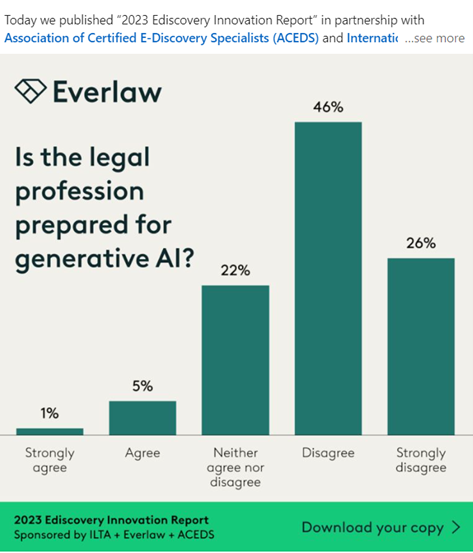
I closed my 2019 column mentioned above with the following and I think it’s still good advice,
“Technology is a tool and the responsibility for using the proper tool in the proper manner resides ultimately with the attorney. As I have said before, we need to keep the attorney in AI.”
“It’s not enough to be aware of AI, we have to understand AI. Or, as the great technologist Elvis Aaron Presley once said, ‘A little less conversation, a little more action please.’”
About the Author...

Tom O'Connor
Gulf Coast Legal Technology Center
E-Discovery Committee Chair

 MEMBER CENTER