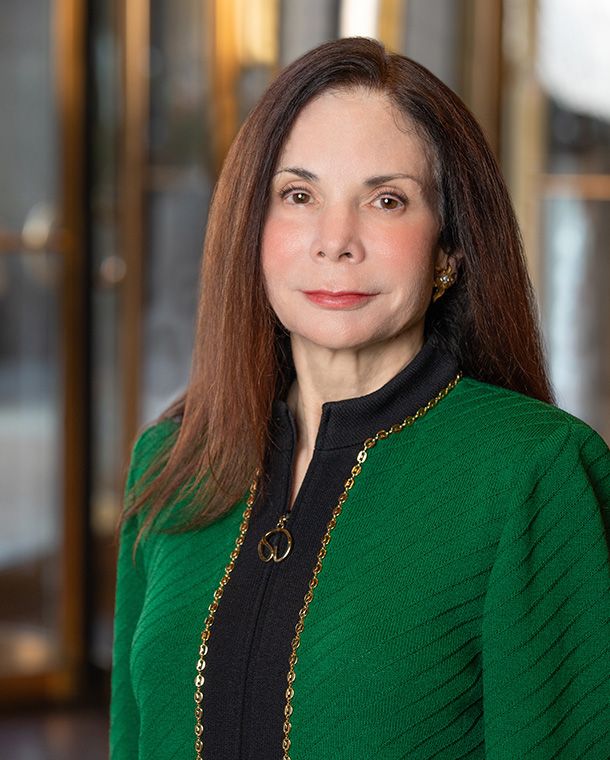
Elia Diaz-Yaeger is a Shareholder in Lugenbuhl’s Insurance Law section, Elia’s primary areas of practice include industrial employment/long-latency lung disease litigation, insurance defense and coverage, environmental law, commercial litigation, and Board Governance. This past September her tenure as the President of the Hispanic National Bar Association (HNBA) came to an end and she transitioned to the much less demanding but still very active role of Immediate Past President.
Elia has been recognized by Best Lawyers since 2018 as well as several Best Lawyers “Women in Law” Editions, a 2019 Lawyers of Color’s “Nations Best” Honoree, and received the 2017 winner of Chambers USA Women in Law Future Leader – Gender Diversity award. These are just a few honors that recognize Elia as both a leader in law and advocacy programs and as a thought leader in the advancement of equity, inclusion, and diversity programs.
Elia actively promotes diversity and inclusion of women and Hispanics in the legal profession through various professional organizations. She is a frequent speaker and CLE presenter and participant in round-table discussions at in-house corporate meetings. She has a master’s degree in Public Relations, and received her J.D. from Loyola School of Law, New Orleans.
In the last twenty-five years, Elia has successfully defended thousands of occupational exposure claims, including exposure to asbestos and silica-containing products. She has served as defense counsel for insurers in commercial and residential property insurance cases resulting from hurricanes, hailstorms, and other first-party claims. Her experience enables her to provide clients with an early strategic plan, a vigorous defense, and efficient litigation. Certified in Cybersecurity Litigation, she also trains boards regarding the ever-growing risk of data breaches.
In addition to her professional pursuits, Elia also serves on several Boards of Directors, including as Secretary for OnPath Federal Credit Union, a Community Development Financial Institution, whose mission is to strengthen the financial health of underserved communities through financial service and education. She is also a member of the Alliance of Latinx Leadership and Policy (ALLP) where she serves on the DOJ and Executive Committee. Her community contributions include Co-Founder and Fundraising Chair of Candy Girls/Life Savers of New Orleans, Co-Founder and Committee Member of The A.D. Crossman Esperanza Library Project, and an active member of the New Orleans Ballet Association. She is a proud member of Muses and volunteers and participates in several social and community programs.
Can you tell us a little bit about the HNBA?
The Hispanic National Bar Association (HNBA) is an incorporated, not-for-profit, national membership association that represents the interests of over 65,000 Hispanic attorneys, judges, law professors, legal assistants, law students, and legal professionals in the United States and its territories. Since 1972, the HNBA has acted as a force for positive change within the legal profession by creating opportunities for Hispanic lawyers and by helping generations of lawyers to succeed. The HNBA has also effectively advocated on issues of importance to the national Hispanic community. While we are proud of our accomplishments, we are mindful that our mission is as vital today as it was nearly five decades ago, especially as the U.S. Hispanic population continues to grow.
Cornerstones of the HNBA’s Mission are to: 1) provide resources for the advancement and professional development of our members and sponsors; 2) support the recruitment, retention, and elevation of Hispanic individuals in law schools, law firms, corporations, the judiciary, and the government; and 3) advocate for solutions for issues that affect the Hispanic community.
How difficult was it being President of the HNBA during the pandemic?
My tenure as National President of the HNBA was both challenging and exhilarating! As I reflect on all that the HNBA accomplished last year, I could not be prouder of the commitment and excellent work that our members demonstrated. My overarching theme was to recognize the power of and utilizing the collective voice of the Hispanic/Latino community to make an impact and effect real change.
When I became President a year ago last September I challenged the Board, Divisions, Sections Committees, task forces and members to take full advantage of the virtual world - to expand our footprint, membership, and reach - to engage our members with a broad range of areas including areas of specialization, societal issues, and matters of importance to our community, and society.
Despite the multiple and unique challenges, our leadership and members embraced the challenge. We used our voice to engage in important and sometimes uncomfortable discussions, to ignite change and have a meaningful measurable impact in and for our community and profession. This was accomplished through various programming addressing: mental health initiatives, issues of racial justice, racism, comprehensive immigration reform, and business development. We also strengthened our mentoring pipeline and professional development programs, as well as addressed the need for further equity, diversity, and inclusion in all areas of our profession. We also implemented a monthly virtual panel/roundtable discussion called Insiders Series. This program provided an opportunity to bring together thought leaders and stakeholders to discuss a broad range of timely topics and concerns that effect our community and profession.
The result of our efforts was immediate. The HNBA was sought out to weigh in on important legal and policy discussions by The Administration, other bar and professional organizations, specialty groups, and corporations. Additionally, we established new liaisons and collaborations with numerous organizations including Building the Bench; the Congressional Library; Latinos for a Fair Judiciary; the FBA; and the AIC Belfer Institute of Latin American Affairs, just to name a few.
I also had the honor of testifying before the House Judiciary Committee regarding diversity on the bench. While the HNBA has a long history of working to fill vacancies in the federal court system, we recognized that this year provided a unique opportunity to increase the number of Hispanics on the federal bench and in leadership positions in the government. Therefore, I implemented the Executive Appointments & Judicial Nominations Endorsement Initiative where the HNBA actively sought out candidates for appointments and nominations. As a result, the HNBA endorsed and provided the current administration and U.S. Senators with 71 candidates for federal judicial vacancies. Additionally, the HNBA in collaboration with the ALLP vetted and endorsed 110 individuals for Executive level, GCs, and Cabinet positions. In all the HNBA vetted and endorsed an astounding total of 181 highly qualified individuals.
This past year has been truly incredible. The work was tireless, but it was also meaningful and gratifying. I must admit that I had a lot of fun! Unquestionably, it was because I had the wonderful gift of working with and being surrounded by a very special group of thought leaders that are not only dedicated, but they are brilliant and fearless – and were willing to step up to the challenge. For that I am extremely grateful. I am proud of how high and far the HNBA voice has reached and the measurable impact that has been made. But there is always more work to be done! I am also grateful for the continuous support that Lugenbuhl provided during my tenure as HNBA President. During an extremely challenging and difficult year, I could not have been successful without the support and encouragement of my firm. A heartfelt thanks to Ben Kadden, Managing Partner, who fully supported and championed my tenure as HNBA President. And a special thank you to Ami Martinez, Marketing and Communications Director; and Yvette Milroy, Legal Assistant, for their dedication and teamwork in providing countless hours assisting me with a wide range of items.
What can the legal profession do to become more diverse?
We can start by acknowledging that diversity matters. True diversity in our profession allows attorneys to reflect the cultures, values, and diversity of our clients, and to bring different cultural, racial, ethnic, religious and gender perspectives to bear to solve problems more effectively for our clients and the community. Diversity across the legal profession is critical to our judicial system and the rule of law. Recognizing and celebrating the differences of others will contribute positively to a firm’s success by widening the client base and improve profitability.
Overall, no matter how you crunch the numbers, diversity in the legal profession has grown at very slow rate over the past decade, with the profession becoming only slightly more diverse. For example, the percentage of female lawyers has increased slowly over the past decades to a mere 37 percent, but there have been little to no gains among people of color. While over 13 percent of Americans are Black, only 5 percent of all lawyers are Black. Similarly, Hispanics/Latinos make up 18.5 percent of the U.S. population but only 5 percent of lawyers. Asians represent 6 percent of the U.S. population and only 2 percent of lawyers. Native Americans represent 1.3 of the population and 0.4 percent of lawyers. Sadly, the percentage of LGBTQ and Disabled lawyers are equally dismal.
The good news is that corporations and clients are recognizing the benefits and need for diversity and are holding the legal profession accountable. As a result, many law firms are developing and implementing comprehensive Equity Diversity and Inclusion (EDI) plans.
It all starts with awareness and education. Awareness is the difference between education on diversity issues and understanding them. Fostering a culture of self-awareness plays an important role in countering bias and promoting diversity and inclusion in law firms. When we are self-aware, this helps us have more emotional intelligence. As a result, we are inherently more likely to notice biases and be appreciative of the diversity that is in our world—and our workplace. Education is necessary to recognize and understand bias. Training on bias is a complex issue, it can be innate or learned as well as implicit or systematic. The goal is to accept and respect the differences between people and to create a workplace and firm culture where everyone can be their authentic self.
As part of this awareness, firms and corporations are taking advantage of inhouse training or the multitude of both in person and online courses available throughout the country to develop their own comprehensive EDI programs that address mentoring, equitable work distribution, real client-facing opportunities, increasing responsibility, and access to key decision-makers.
Now that you are HNBA Immediate Past President, what are you looking forward to?
I am looking forward to devoting more time to focus on my law practice and having my nights and weekends back. The HNBA Corporate Counsel Conference will be held in New Orleans in March 2022, and I am assisting in planning the logistics, and I am looking forward to seeing everyone in person! My personal experience over the past year has only strengthened my resolve to continue to make the work and volunteerism that I do more meaningful so that it contributes in a measurable way to our community and to society. So, I am looking forward to searching for the next opportunity to make a difference. And of course, it goes without saying that I am looking forward to Mardi Gras! I have an art studio in my home dedicated to all that glitters and shines. My girlfriends and I are working on our Muses shoes and the glitter is flying!
Lynn Luker
Women in the Profession Committee Chair
Each month NOBA's Women in the Profession Committee will spotlight a different female lawyer. WIP aims to support and celebrate successful women lawyers in New Orleans and their accomplishments. If you are interested in writing an article, please contact Lynn Luker for more information.

 MEMBER CENTER